
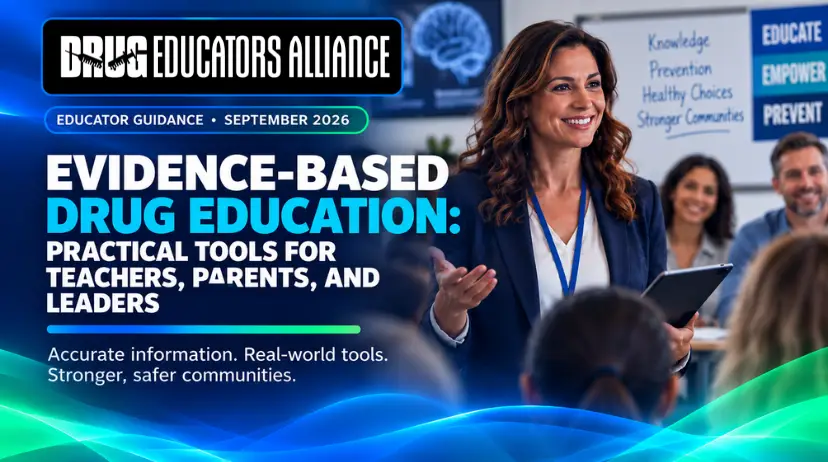
Good drug education does more than tell young people what not to do. It gives them truthful information, practical decision-making tools, and adults they can trust when real situations arise.
Teachers, parents, youth leaders, law enforcement professionals, prevention specialists, and community organizations can all play a role in helping young people understand drugs and make informed decisions.
The strongest educational approach is not built on slogans, exaggeration, or fear. It combines age-appropriate facts with discussion, real-world scenarios, life skills, help-seeking, family communication, and realistic ways to measure what students actually learned.
Key Takeaways
- Facts are important, but facts alone are not enough. Young people also benefit from decision-making, refusal, exit, help-seeking, and coping skills.
- Credibility matters. Information should be truthful, clear, age appropriate, and presented without exaggeration or scare tactics.
- Real situations should be discussed before they happen. Students can practice what to do when they face pressure, uncertainty, an unknown substance, or a friend who may need help.
- Education works better when adults are prepared too. Teachers and parents need practical language, clear boundaries, and referral procedures—not just information about substances.
- Measurement should match what was actually taught. Knowledge, confidence, awareness of resources, and responses to scenarios can be measured without claiming that education alone determines future behavior.
Drug Education That Prepares Young People for Real Decisions
Young people will eventually make decisions without a teacher, parent, coach, counselor, or police officer standing beside them. Drug education should help prepare them for that reality.
A message that simply says “don’t do drugs” may leave important questions unanswered: What is this substance? Why is it risky? Which claims are true? What happens when friends disagree? What if someone is already using? What should I do if a pill, vape, drink, edible, or powder appears at a party?
Consider a student hearing two completely different messages about vaping. A peer says it is harmless. An adult says it will ruin the student’s life. Neither extreme necessarily gives that young person the information or judgment needed to evaluate the situation carefully.
A more useful approach explains what the product is, what is known about its risks, how social influence and marketing can affect choices, what the student does not know about an unknown product, and what practical options are available when pressure appears.
What does “evidence-based” mean?
In prevention and education, the term evidence-based generally refers to a specific program, strategy, or method that has been studied and supported by appropriate research.
That label should not be applied casually. A curriculum or program should only be described as evidence-based when the available evidence supports that specific claim.
Schools and community organizations can still draw from widely used, evidence-informed educational practices without claiming that every lesson or curriculum has been scientifically proven. Those practices can include:
- interactive discussion instead of lecture alone;
- realistic scenarios and decision practice;
- age-appropriate factual information;
- opportunities for young people to ask questions;
- reinforcement and follow-up over time;
- clear pathways for seeking help and responding to emergencies.
Drug education is not only for students
Parents, educators, coaches, law enforcement professionals, employers, youth leaders, counselors, and community organizations may all encounter situations where accurate drug information and practical communication skills are valuable.
Drug Educators Alliance works nationally with educators and community partners through presentations, educator outreach, educational resources, partnerships, and training. The organization’s work and partner relationships have involved thousands of educators and reached millions of young people across all 50 states.
Key Components of Practical Drug Education for Schools
Drug education becomes easier to use when schools have a repeatable framework instead of relying entirely on one presentation, one assembly, or one annual awareness event.
Age Appropriate
Match the information, examples, language, and level of detail to the students’ age, questions, and likely real-world situations.
Factual
Present information without exaggeration so students have a credible source they can return to when they hear conflicting messages.
Practical
Include decision skills, help-seeking, refusal strategies, and ways to leave uncomfortable or unsafe situations.
Component 1: Match the lesson to the age and situation
Students at different ages need different levels of detail and different examples.
Younger students may need simple guidance about medicine safety, body safety, and trusted adults. Middle-school students may benefit from discussions about peer pressure, social media, vaping, unknown substances, and the difference between a medicine taken as directed and a pill obtained from another source.
Older students may be ready for more detailed conversations about impairment, driving, fentanyl, prescription medications, cannabis and THC products, alcohol, emergencies, and how to respond when a friend may be in danger.
Component 2: Educate without exaggeration or judgment
Students have access to information instantly. If an adult makes a claim that is easy to disprove, credibility can disappear quickly—and the next accurate warning may be ignored too.
Drug Educators Alliance emphasizes truthful, factual communication without lectures, judgment, or scare tactics. That does not mean minimizing risk. It means explaining risk accurately and giving young people enough context to understand why the information matters.
Component 3: Teach what to do, not only what to know
Facts answer the question, “What is this?” Practical skills answer another important question: “What do I do if this happens to me?”
Drug education can include:
- recognizing pressure and uncomfortable situations;
- slowing down before making a decision;
- realistic refusal or exit language;
- calling or texting a trusted adult;
- moving toward a safer environment;
- knowing when a situation may require emergency help.
Component 4: Keep adult messages consistent
Students may receive drug information from teachers, parents, counselors, coaches, law enforcement officers, physicians, social media, and friends. Adults do not need to use identical words, but shared principles can reduce confusion.
“We focus on safety.”
“You can ask questions.”
“Ask for help early.”
“If you do not know what something is, do not guess.”
“One decision does not define a person.”
Practical Drug Education Tools for Parents and Teachers
Some of the most useful prevention tools are simple enough to use during an ordinary two-minute conversation. Parents and educators do not always need a formal lesson. Sometimes they need a reliable way to begin.
A three-part conversation opener
- Start with care: “I care about you and your safety.”
- Ask instead of assuming: “I’m hearing more about vaping, pills, cannabis products, and other things showing up around young people. What are you seeing?”
- Make help possible: “If you ever get into a situation you don’t know how to handle, call me. We can deal with the situation first and talk about everything else later.”
The exact words can change. The goal is to make it easier for a young person to communicate before uncertainty becomes a crisis.
A simple PAUSE decision tool
Young people may benefit from a short mental framework they can remember when they need a few seconds to think.
Integrating Drug Education Into Existing School Curricula
Schools do not necessarily need a completely new class to reinforce drug education. Relevant concepts can fit into existing courses, advisory periods, student activities, parent programs, health classes, driver education, and community events.
Health or PE can address decision skills and body effects. Science can support discussions about the brain, substances, and impairment. Driver education can address impairment and decision-making. Advisory periods can address coping, relationships, pressure, and help-seeking.
Short lessons can be easier to integrate than a new standalone course and can reinforce information over time.
Teachers and presenters should know the learning objective, how to facilitate discussion, what to do if a student discloses a concern, and where to refer questions outside their role.
Parent nights, community presentations, school resource officers, counselors, youth organizations, and other partners can reinforce information when their roles and messages are clearly defined.
Want to be better prepared to teach these conversations?
Drug Educators Alliance now offers an 8-hour, instructor-led Drug Educator Training designed for educators, law enforcement personnel, prevention professionals, youth leaders, parents, and others who work with young people.
The training goes beyond drug facts. Participants work through practical communication, myths and media literacy, life skills, real-world situations, disclosures and referrals, teaching practice, and ready-to-use curriculum and resources for working with youth.
Q4 online special: $199 per participant. Private in-person training is also available for schools, agencies, organizations, and communities.
Continuing education recognition varies by state, licensing authority, district, and profession. Drug Educators Alliance can provide course information for submission to the appropriate reviewing authority.
Measuring Drug Education Without Overpromising
Measurement matters, but prevention outcomes are complicated. A school should not conclude that one lesson caused a later behavior change simply because both occurred.
A more useful approach is to measure outcomes that are directly connected to what was actually taught.
Practical measures can include:
- knowledge before and after instruction;
- confidence answering scenario-based questions;
- awareness of school or community resources;
- ability to identify a trusted adult;
- understanding of help-seeking and emergency steps;
- feedback from educators and families;
- questions students continue to ask after instruction.
These measures can help educators improve future instruction without claiming that a program guarantees reduced drug use, arrests, addiction, recidivism, or other long-term outcomes.
Use results to improve the next lesson
Measurement becomes more useful when it leads to action.
- If students cannot identify a trusted adult, strengthen that part of the lesson.
- If students understand a drug fact but struggle with a scenario, add more decision practice.
- If staff members are unsure how to respond to a disclosure, provide additional guidance and referral procedures.
- If parents want more help discussing a topic, provide additional family resources and conversation tools.
Frequently Asked Questions About Drug Education
What is drug education?
Drug education is structured learning that helps people understand substances, potential risks, and practical ways to make informed decisions. Depending on the audience, it may also include decision-making, refusal strategies, help-seeking, medicine safety, impairment awareness, and emergency guidance.
Does talking about drugs encourage young people to experiment?
Drug education does not need to provide instructions for drug use. It can focus on factual health and safety information, myths and misconceptions, social pressure, decision-making, and what to do when a student needs help.
What are drug education programs?
Drug education programs can include classroom curricula, presentations, community education, parent resources, workplace education, educator training, or diversion-oriented courses. Different programs use different methods and should be evaluated based on their actual content, objectives, evidence, and intended audience.
Does Drug Educators Alliance provide free youth presentations?
Yes. Drug Educators Alliance provides free youth drug education presentations when staffing and funding are available.
Does Drug Educators Alliance offer Drug Educator Certification?
Yes. Drug Educators Alliance offers live, instructor-led Drug Educator Training online and through private in-person sessions. Participants who successfully complete the applicable course requirements receive a Drug Educator Certification valid for two years. The program also includes a pathway to Gold Seal recognition through verified field delivery.
Can the training qualify for continuing education credit?
Continuing education requirements vary by state, profession, district, employer, and licensing authority. Drug Educators Alliance can provide a program information packet, course outline, learning objectives, and supporting materials that may be submitted to the appropriate reviewing authority. Approval is determined by that authority and is not guaranteed.
Give educators and families information they can actually use
Drug Educators Alliance works to prevent drug abuse through truthful, factual, age-appropriate education, early intervention, and community collaboration.
Explore educational resources for schools, families, law enforcement, youth organizations, and communities—or learn how to become a certified Drug Educator through our live training program.
Explore Drug Educator Training → Explore Drug Education Resources